
Snap, and the View Turns to Dust
When Thanos snapped his fingers, half the universe didn't just vanish.
It drifted away as dust, slowly enough for everyone to notice.
When we delete a row in our app, it just blinks out of existence.
Who brought the damn gauntlet to the party?
Rayan Selmi just open-sourced dissolve, an animation library that turns any React Native view into dust, sand, embers, pixels or melting goo.
We put a ref on a component, call dissolve(), and it breaks apart into grains.
It works on any view, not one special widget, and even runs in Expo Go.
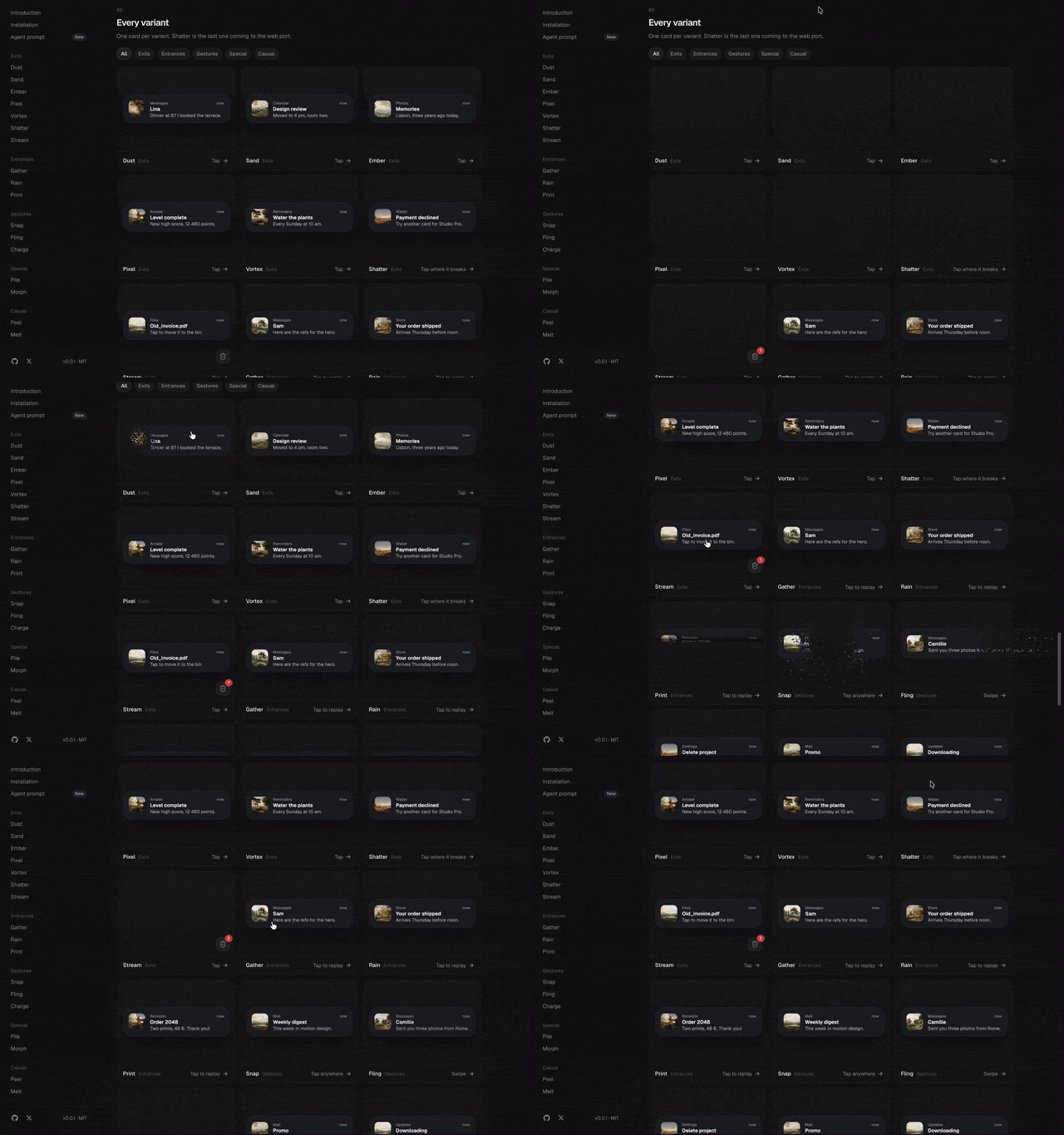
dissolve's gallery of effects, from Rayan's launch video
The dust is a three-step trick.
First, React Native Skia takes a snapshot of the view with makeImageFromView, so we're animating a picture, not live UI.
That picture is cut into up to 6,000 grains and drawn with Skia's <Atlas> (a component that draws thousands of image pieces in a single call).
Then Reanimated 4 moves every grain on the UI thread in one pass per frame, skipping grains that have settled.
const { ref, dissolving, dissolve } = useDissolve();

<Pressable
  onPress={async () => {
    await dissolve({ preset: 'sand' });
    onRemove(item.id);
  }}
>
  <View
    ref={ref}
    collapsable={false}
    style={{ opacity: dissolving ? 0 : 1 }}
  />
</Pressable>
We hide the real view while it crumbles, then remove it from state once the await finishes.
The gauntlet comes fully loaded, too.
There's a snap that bursts from where we tapped, a fling that follows the swipe, a peel that pulls a view off like a sticker, and glass that shatters.
Ready-made components like swipe-to-delete, toasts and a scratch card are copied into our project with npx dissolve-ui add, the shadcn/ui way, so we own the code.
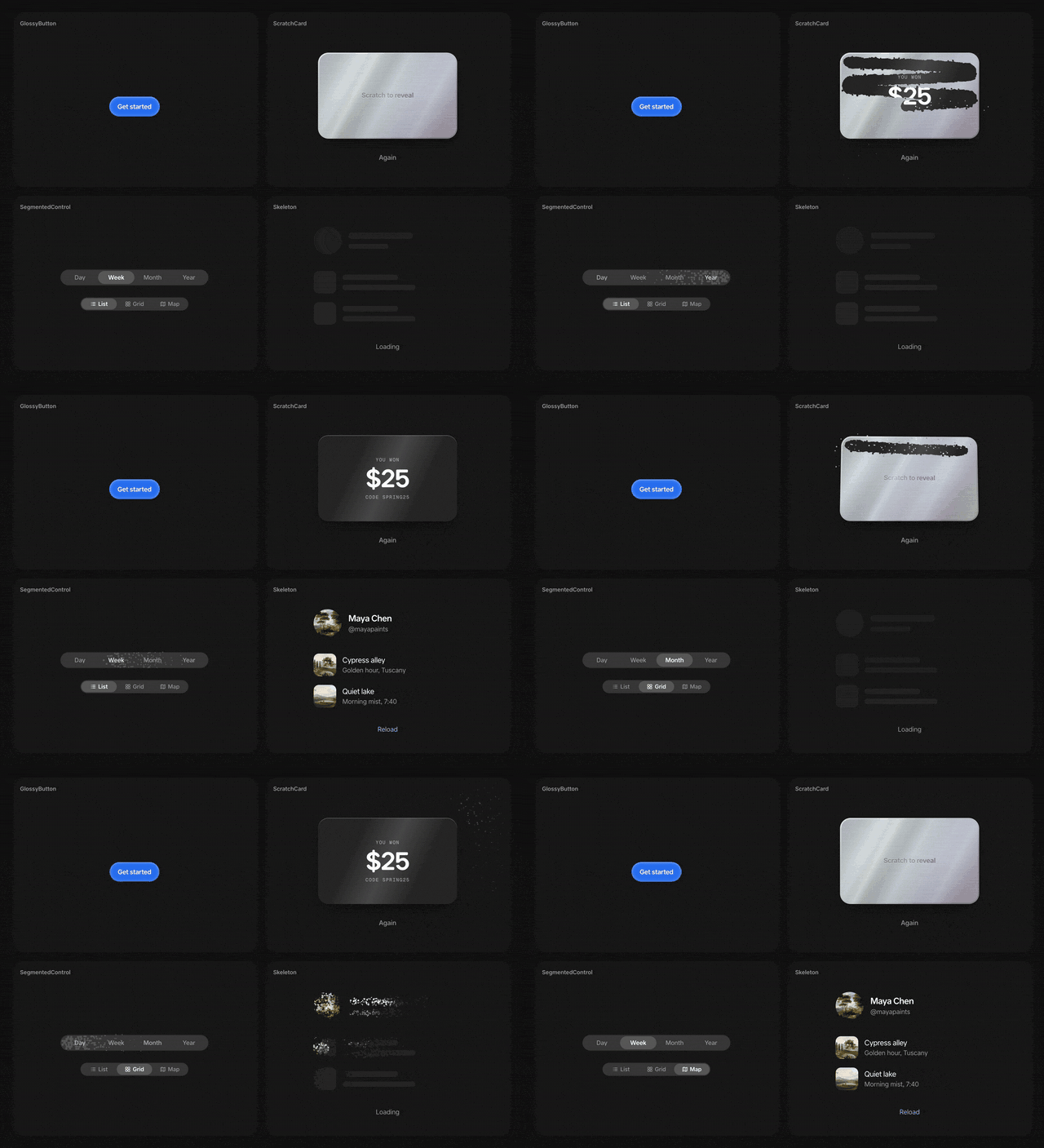
A scratch card and loading skeleton from dissolve's newest components
Since 19 November, the same components also run on the web as plain React.
It's brand new, the components need NativeWind v5, and the README's known good setup is Expo SDK 57.
Thanos needed six stones to make things disappear.
We need one hook and a list row we're happy to sacrifice.
Who is the master of the universe now…?
Okay, that was a little bit over the top, but where is the fun if you don’t risk from time to time?
👉 dissolve
The complete guide to React Native OTA updates
Thinking about OTA updates for your React Native app, or just getting started?
You probably have the same questions most teams do.
What can you actually ship over the air?
Will Apple and Google allow it?
Which tool should you pick, and how do you avoid breaking the app for everyone with a bad release?
Our new guide answers all these questions and more, so you can make good decisions from day one instead of learning the hard way.
It covers what the stores allow, how to make the case to your team, how to choose a tool, and the five habits that keep every release under control.
Doing the Voices, Offline
Now the phone can do the impression itself.
BOOM.
Software Mansion AI Labs just released Reverb-TTS, its first model, and it ships in React Native ExecuTorch v0.11.1 (Software Mansion's library for running AI models on the device).
It's a text-to-speech (TTS) model that clones a voice from a short recording, with no training step, and speaks English, German, French, Spanish, Italian, Polish and Portuguese.
Any cloned voice can speak all seven, so we can record ourselves in English and hear ourselves in Polish.
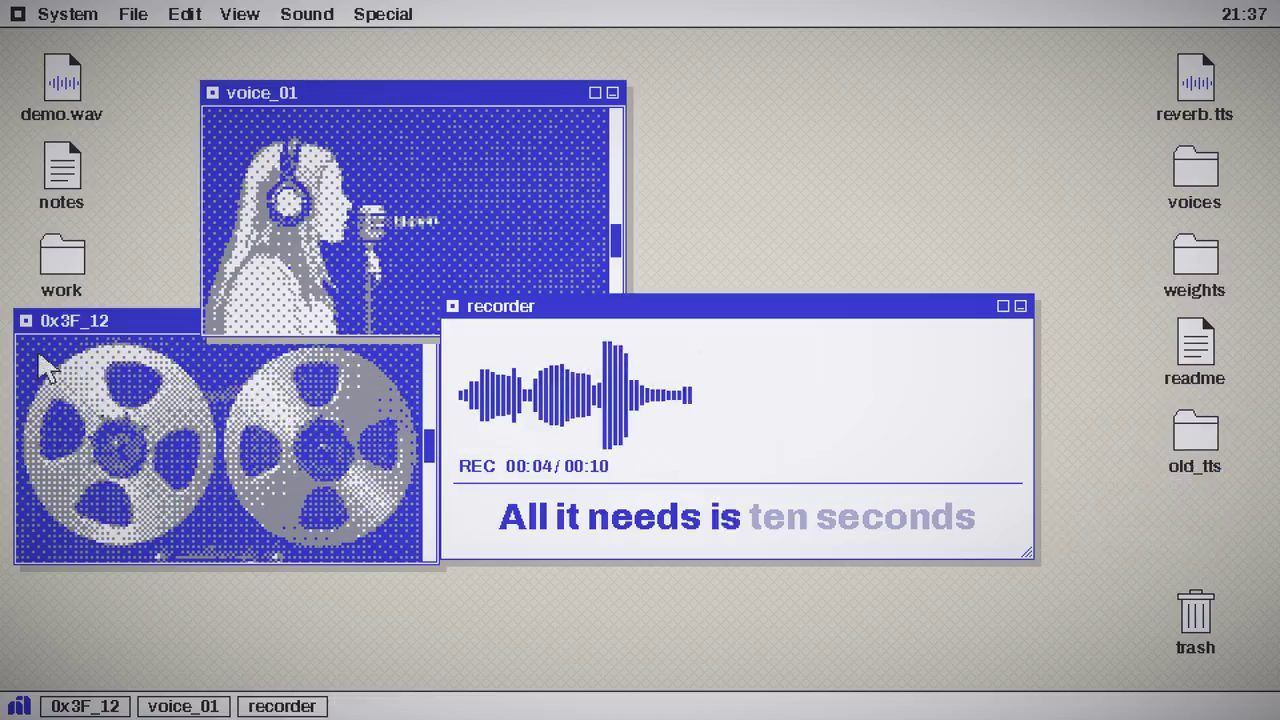
From Software Mansion's launch video: a short clip is all Reverb needs
Learning a voice is surprisingly low effort.
We give encodeVoice() a 24 kHz mono recording and a word-for-word transcript of it.
An audio codec turns the clip into tokens that capture the speaker's timbre, pace and mood.
The model then fills in the tokens for our new sentence in a few parallel passes, and a decoder turns them into audio.
const tts = useTextToSpeech(
  models.textToSpeech.REVERB.DEFAULT,
);

// 24 kHz mono, 1-20 s, plus its exact transcript
const voice = await tts.encodeVoice(
  recording,
  'What the recording says.',
  'en',
);

const chunks = tts.synthesize('Any text, in our voice.', {
  voice,
  language: 'en',
});
The voice comes back as plain data, so we can save it and skip the recording next time.
And the impression holds up.
By Software Mansion's own benchmarks, it has the lowest word error rate on the Open TTS Leaderboard's MiniMax test and runs over 20× faster than real time on an iPhone 17.
It does that with less than half the parameters of OmniVoice, the open model it was pruned from.
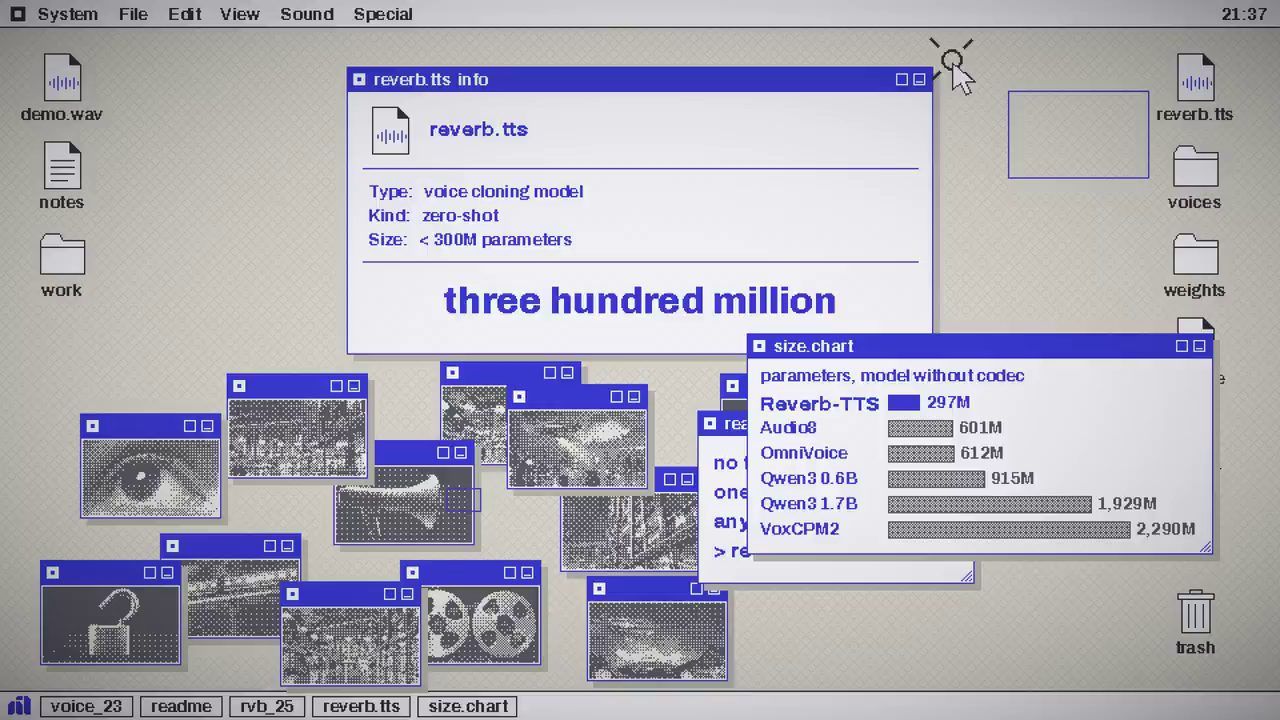
Reverb's size next to other open voice-cloning models, from the launch video
There's a catch, of course.
The weights are CC BY-NC 4.0, so it's non-commercial use only for now.
The download is 413 to 833 MB, and the voice-cloning encoder adds up to 176 MB more on the first encodeVoice() call.
The model card also asks us not to impersonate real people, which rules out an impressionist's entire career.
They needed years of practice to nail a voice.
Our users' phones need about ten seconds.
👉 React Native ExecuTorch Text-to-Speech
Before you Go: The Robots Are Being Counted
Bob Poláček opened up a free, MIT-licensed slice of his Appetite UI kit: 10 React Native components, 178 design tokens and an Expo SDK 58 app that opens in Expo Go.
It comes with an AGENTS.md for Claude Code and Cursor, and the paid Appetite UI Code grows it to 41 React Native components and an App Starter, from $79.
Igor Luchenkov built visual testing for coding agents: it diffs our screens against their baselines, posts a verdict on the PR, and hands regressions to Claude Code, Cursor or Codex over MCP.
React Native apps bring their own screenshots (the Expo example takes them with Maestro), and the free plan's 10,000 snapshots a month means our agents finally have to look at what they broke.
DevTools moves to React DevTools 8 with a new Suspense panel, so we can finally see what our app is sitting around waiting for.
C++ Native Animated is now stable, and the Performance panel shows frame timings and screenshots by default.
Shared Element Transitions are on by default, and they now fly the real view across instead of a copy, so a playing video keeps playing mid-flight.
We can also drop a shared value straight into Animated.Text, like {sv}%, without any workaround.
Worklet runtimes can now open a WebSocket of their own, and background runtimes can be stopped with abortWorkletRuntime.
The new runOnRNSync lets the UI thread ring the React Native runtime and wait on the line for an answer.
Its BottomSheet swaps @gorhom/bottom-sheet for real native sheets through React Native True Sheet, Liquid Glass and all on iOS 26.
Toasts were rebuilt too, so firing toast.show() ten times in a row no longer makes Android sweat.
Fresh off last week's 1.0, Software Mansion's sheet picks up maxWidth and placement, so it stops stretching across the whole width of a tablet.
It also loses that little jump on the final frame when opening to full height.
Canvases now render at full rate on ProMotion Macs, and drawAtlas finally behaves under a perspective matrix.
The Android binaries now come straight from GitHub releases.
Cloud simulator sessions can now attach crash reports and network captures as HAR files, so our agents' evidence pile just got taller.
Its telemetry also learned to spot Grok Bot and Claude Cowork, so the robots are officially being counted.
📖 Agentic Workflows with Expo Simulators
Jacob from Expo turns a TestFlight screenshot into a filed issue, a reproduced bug and a fix PR, with no human needed until the merge button.
He also sends a swarm of five cloud simulators after an app's core flows at once, each one posting its own verdict on the PR.